What is Trigonometry?
Trigonometry, or "Trig" for short, is the study of the relationships between the angles and sides of triangles. We will mostly be dealing with right triangles, but all triangles can be analyzed with trig. Trig is a vital branch of mathematics because it has many real world applications in engineering, architecture, optics, and many more fields.
Trigonometric Functions
The trigonometric functions are the main functions that are used to describe the relationships between angles and sides of figures.
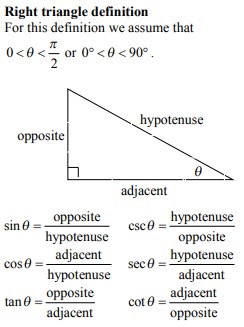
The triangle below is a good way to visualize what the reference angle (theta) is, and what the different sides are.
Sine, Cosine, and Tangent
The three basic trig functions are the Sine, Cosine, and Tangent functions. Let's begin by looking at the sine function.
In the context of a right angle, the sine function, written as sin(theta) is equal to the division of the opposite side of the reference angle (theta) by the hypotenuse, or long side, of the triangle.
sin(theta) = opposite/hypotenuse
Similarly, the cosine function, denoted as cos(theta) is defined as the division of the adjacent side to reference angle divided by the hypotenuse.
cos(theta) = adjacent/hypotenuse
The tangent function, denoted as tan(theta), is defined as the division of the opposite side of the reference angle by the adjacent side.
tan(theta) = opposite/adjacent
Cosecant, Secant, and Cotangent
Since the previously described trigonometric functions are described as fractions, we can take the reciprocals of the functions and obtain 3 new functions. The Cosecant function is the reciprocal of the Sine function, the Secant is the reciprocal of the Cosine, and Cotangent is the reciprocal of Tangent.
csc(theta) = 1/sin(theta) = hypotenuse/adjacent
sec(theta) = 1/cos(theta) = hypotenuse/opposite
cot(theta) = 1/tan(theta) = adjacent/opposite
Trigonometric Identities
All of the trigonometric functions are related to the unit circle so it should naturally follow that there are ways of writing them in terms of each other. A way of writing a trigonoetric function in terms of other trigonometric functions is called a trigonometric identity. Below are some of the most common trigonometric identities that you will encounter in a trig course.
The Reciprocal Identities
sin(theta) = 1/csc(theta) & csc(theta) = 1/sin(theta)
cos(theta) = 1/sec(theta) & sec(theta) = 1/cos(theta)
tan(theta) = 1/cot(theta) & cot(theta) = 1/tan(theta)
Pythagorean Identities
sin^2(theta) + cos^2(theta) = 1
1 + tan^2(theta) = sec^2(theta)
1 + cot^2(theta) = csc^2(theta)
Quotient Identities
tan(theta) = sin(theta)/cos(theta) & cot(theta) = cos(theta)/sin(theta)
Cofunction Identities
sin(theta)= cos((pi/2)-theta), & cos(theta)= sin((pi/2)-theta)
sec(theta)= csc((pi/2)-theta), & csc(theta)= sec((pi/2)-theta)
tan(theta)= cot((pi/2)-theta), & cot(theta)= tan((pi/2)-theta)
Half Angle Identities
sin(theta/2)=+/-sqrt((1-cos(theta))/2)
cos(theta/2)=+/-sqrt((1+cos(theta))/2)
tan(theta/2)=+/-sqrt(sin(theta)/(1+cos(theta)))= +/-sqrt((1-cos(theta))/sin(theta))
Sum/Difference Identities
sin(alpha+/-beta) = (sin(alpha)cos(beta)) +/- (cos(alpha)sin(beta))
cos(alpha+/-beta) = (cos(alpha)cos(beta)) +/- (sin(alpha)sin(beta))
tan(alpha+/-beta) = (tan(alpha) +/- tan(beta))/(1+/- (tan(alpha)tan(beta))