College of Law Beats Harvard in National Moot Court Competition

February 19, 2026
Preparation paid off for the UNT Dallas College of Law team of students who beat Harvard Law School in the National Moot Court Competition held last month in New York City.
Observers called the upset victory a “Cinderella story.” It occurred in the octofinal round among 16 teams, just before the quarterfinals. The Harvard team was the second-seed.
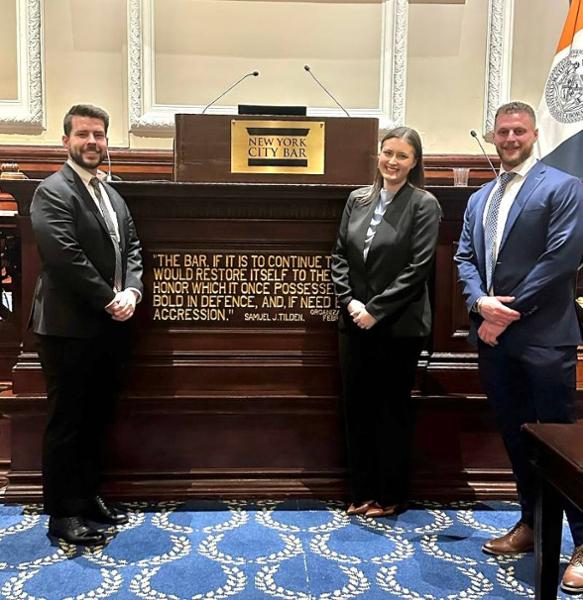
The three-person UNT Dallas team of Hamilton Hayers, Victoria Saucedo and Andrew Brown prevailed on both brief and oral argument, winning by nine points. They eventually advanced to the semifinal round, which concluded with a three-point decision in favor of Texas Tech University.
Out of 191 teams competing from 121 schools nationwide, UNT Dallas College of Law team placed third.
Hayers said teamwork was central to managing the scope of the competition’s challenges.“This competition required significantly more research and writing than a typical moot court problem,” Hayers said. “Working closely as a team allowed us to produce a brief that reflected our collective effort.”
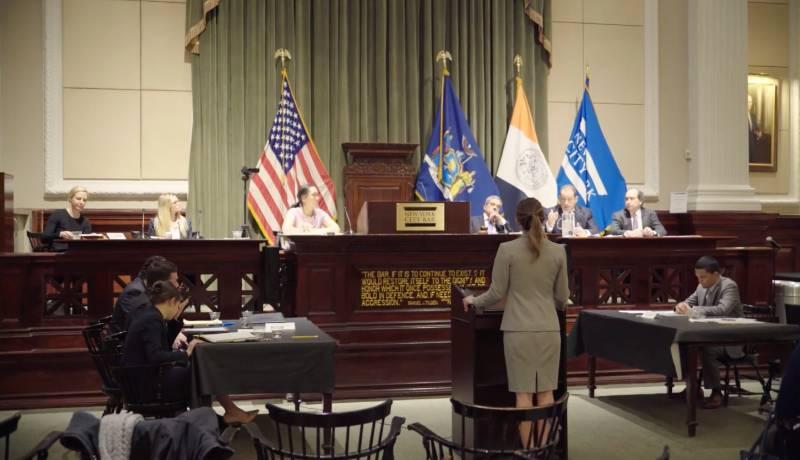
The annual event is one of the nation’s longest-running inter-law school advocacy programs. Hosted annually by the New York City Bar Association in partnership with the American College of Trial Lawyers, the competition brings together law schools from across the country in a process designed to mirror appellate practice. Students analyze a record on appeal, draft formal briefs and present oral arguments before panels of attorneys and judges.
Preparation began months in advance and centered on a structured, team-based approach to research, writing and practice. Saucedo said the group prioritized precision, repetition and accountability throughout the process. “Our preparation started with drafting and refining the brief as a team,” Saucedo said. “We read it line by line, challenged each other’s reasoning and built a consistent practice schedule. Feedback was part of every stage.”
Schools participating in the competition advanced from regional rounds to national competition through successive stages of written and oral advocacy. The UNT Dallas team progressed through those rounds to reach the semifinal stage.
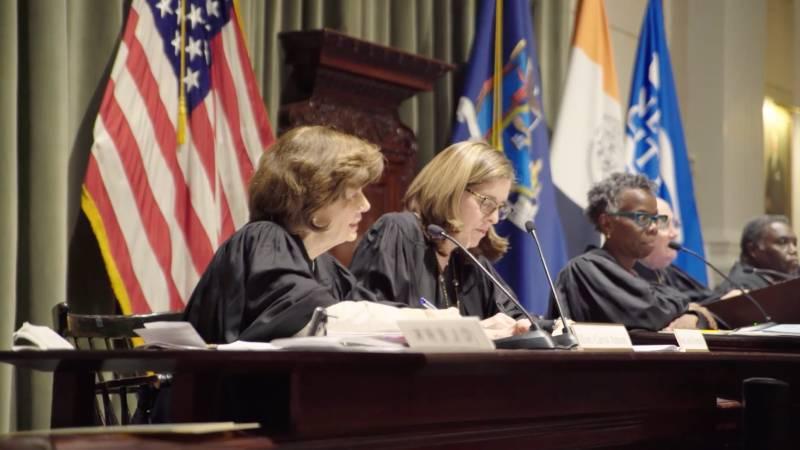
Saucedo said the national rounds required adaptability as much as preparation. “The strongest rounds were the ones where we adjusted in real time to what the judges were asking,” she said. “We trusted the process we built and stayed disciplined in how we approached each argument.”
For Brown, the experience underscored the connection between moot court and preparation for legal practice, particularly in litigation. “Moot court provides an opportunity to engage deeply with legal issues, develop persuasive arguments and work collaboratively toward a shared goal,” Brown said. “Those experiences translate directly to practice.”
He pointed to the team’s semifinal win at the regional competition in Houston as a defining moment in their development. “We advanced because of the work that went into our brief and the collaboration behind it,” Brown said. “It showed the value of preparation and teamwork before we even stepped into the oral rounds.”
The experience also strengthened the team’s research and writing process, including expanded use of scholarly sources, structured editing and candid peer feedback. Participation in the competition reflects the role of moot court in legal education by providing practical training in appellate advocacy, legal writing and preparation for the profession.
Categories: