Please give as much detail as possible, in order for the CARE Team to address the
concern to the best of our abilities.
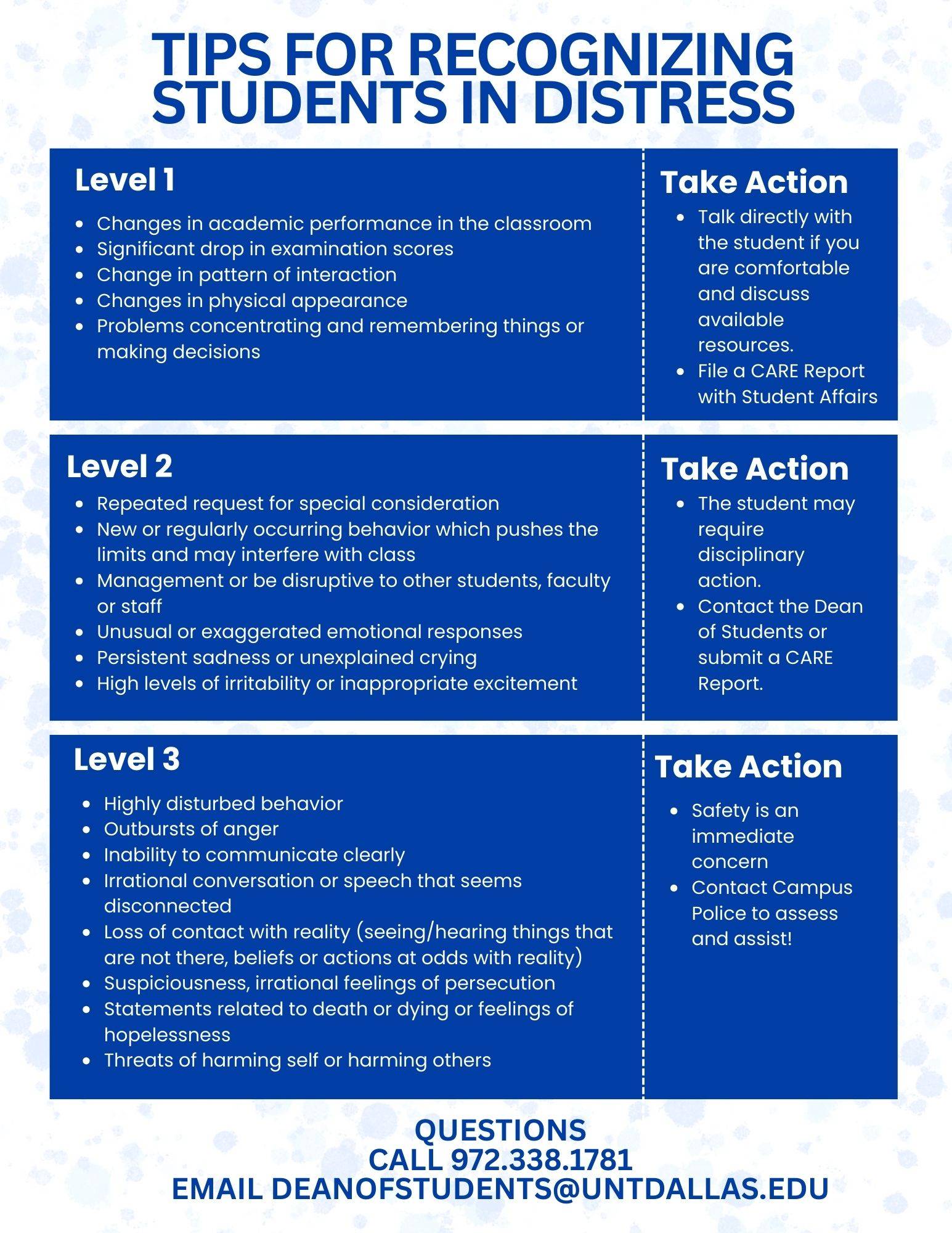
Submit a CARE referral when you are concerned about a student’s well-being, ability
to manage daily responsibilities, or need for assistance connecting with support.
Concerns may arise in person, in class, through email, or in online interactions.
You do not need to diagnose a problem or have complete information. Describe what
you observed, what the student shared, and why you are concerned. A single significant
concern may warrant a referral; you do not need to wait for a pattern.
EMERGENCY OR CARE REFERRAL?
Call 911 for immediate danger or a medical emergency, including an active suicide
attempt, suspected overdose, serious injury, or imminent threat of violence. Do not
wait for a CARE response.
For suicide or emotional crisis support, call or text 988. A CARE referral can help
coordinate follow-up, but it does not replace immediate crisis assistance.
If you are concerned someone may be missing or in immediate danger, contact police
promptly rather than waiting for the referral to be reviewed.
WHAT SHOULD I INCLUDE?
Provide as much relevant information as you know:
- Student’s name and identifying information, if available.
- Specific behavior, statements, or support needs.
- Dates, locations, frequency, and significant changes.
- Exact words when relevant, rather than interpretations.
- Whether you observed the concern directly or someone reported it to you.
- Outreach or assistance already offered and the student’s response.
- Any immediate safety concern and whom you have contacted.
- Your contact information so the team can clarify the concern.
Helpful example: “Jordan attended regularly until September 15, then missed four classes
and two assignments. On September 28, Jordan emailed, ‘I lost my housing and don’t
know where I’ll sleep.’ I offered resource information but have not received a response.”
Less helpful example: “Jordan is unstable and needs help.”
Include relevant information rather than an entire medical history or unrelated personal
details. Do not delay a referral to collect more information
Descriptive table caption (for assisstive technology only, will not display)
| Concerns & Practical Examples for Referrals |
|
| Concern |
Practical Examples |
| Significant changes in attendance or engagement |
A previously engaged student stops attending, misses several assignments, and does
not respond to outreach. A student withdraws from activities and says they are struggling
to keep up. |
| Emotional distress affecting daily functioning |
A student repeatedly becomes overwhelmed in class, reports persistent distress, or
says they cannot manage everyday responsibilities. |
| Hopelessness or concerns about self-harm |
A student says others would be better off without them, expresses a wish to die, or
shares concerning messages about self-harm. Seek immediate assistance for safety concerns;
do not rely on the referral form alone. |
| Food, housing, or other basic-needs insecurity |
A student reports skipping meals because they cannot afford food, sleeping in a vehicle,
facing eviction, or lacking essential utilities. |